These boys have figured out how to get across the flooded area without getting wet. In fact they were having a lot of fun!
Thursday, June 21, 2012
High Waters
These boys have figured out how to get across the flooded area without getting wet. In fact they were having a lot of fun!
Friday, May 4, 2012
Mourning Cloak Butterfly
Every spring I look forward to the first appearance of my favourite butterfly - the Mourning Cloak. It's usually one of the first species to appear because it is one of only a few butterfly species that overwinters as adults. All they need is a few sunny hours to awake from a form of hibernation and make their first appearance. The newly emerged butterflies seek a mate and then the females lay eggs on tender green leaves as they start to appear. Willows and members of the poplar family are favourite host plants. Then the adults die and we have to wait until later in the summer to see this spectacular butterfly again. The name is an English translation of the common name for this species from Germanic languages. The English themselves call Nymphalis antiopa the Camberwell Beauty. Mourning cloaks have been out for a few weeks already this spring but it took until today before I met up with one while I was carrying a camera and had an opportunity for a shot.
Sunday, April 29, 2012
April Showers Bring... Grebes!
The ice came off Maxwell Lake around midweek, which is a little later than average. Maxwell is usually ice-free before other area lakes, so early migrating waterfowl always find it an attractive stopover. Friday evening April 27 was a special event - 3 grebe species were on the lake. There was a group of 25 red-necked grebes, all tucked in and resting after probably a long flight. Scattered around in singles were 4 horned grebes. These birds were all diving for dinner. Once came up with a large leech that it proceeded to batter and toss for several minutes before it went down the hatch. The last grebe was a single bird that rarely shows up in this area - a pied-billed grebe. It was close to the red-necked grebes, which made me think it might have been migrating with them. I think this is only the 3rd record of pied-billed grebe that I have on Maxwell Lake in 25 years.
Unfortunately I didn't have a camera with me. I went back the next day and there were just 2 red-necked and 1 horned remaining. The first photo is of the two red-necked grebes. Amazingly, the horned grebe had another leech - what are the chances of seeing that on 2 consecutive days? This time I got a grainy photo from long distance. You can clearly see the leech curled in a reverse J dangling from the bird's bill.
Unfortunately I didn't have a camera with me. I went back the next day and there were just 2 red-necked and 1 horned remaining. The first photo is of the two red-necked grebes. Amazingly, the horned grebe had another leech - what are the chances of seeing that on 2 consecutive days? This time I got a grainy photo from long distance. You can clearly see the leech curled in a reverse J dangling from the bird's bill.Thursday, April 12, 2012
Tracks in the Snow
This photo was taken last month along Pinto Creek north of Hinton. Although it had snowed since the critter that made the tracks passed by the story was still pretty clear. The tracks were made by a river otter. Two clues are distinctive. First, the track clearly shows a pattern of a few jumps followed by a long groove. This is typical otter behaviour. Otters never run if they can slide! The otter took a few strides then slid on its belly. Second, the track leads directly to a hole in the ice, which the otter used to access the underwater world that holds the fish it depends on for food on a year-around basis.
River otters regularly visit the Beaver Boardwalk. Unfortunately they always seem to time their visits to when I'm not there. I get about 2 reports a year from Boardwalk users saying they saw an otter. Lucky them! Otters are uncommon in the Foothills area and not many people are fortunate enough to spot one.
Barred Owl Nestbox
Another experiment in assisted housing is underway at the Beaver Boardwalk! Using plans from a barred owl research program I built a nestbox in the hopes of attracting a pair of house-hunting barred owls. The box is made out of 3/4 inch pressure-treated plywood screwed together and chained to a big white spruce tree. Barred owls are cavity nesters but they don't make cavities. Also they are pretty big - much too big to fit into a pileated woodpecker hole. So they have to find a large natural cavity to nest in. In our area a study some years back by Lisa Takats Priestley found them nesting mostly in large balsam poplars or aspens with natural cavities formed by large branches falling off or the trunk breaking to expose internal rot in a chimney cavity which is open to the sky. I hope the pair that lives in the Maxwell Lake area will eventually find their new option and decide to move in. I don't expect much action this year as I believe the pair has already found a nest site.
The photo shows me posing with the installed box about 20 m up a big spruce tree. I'm not going to disclose the location because owls need their privacy, but I'll keep watch and if a pair moves in I'll let folks know and offer guided tours on request.
Thursday, April 5, 2012
Another Sign of Spring
Pussywillows have been out for a few weeks and now the aspen buds are starting to burst in Hinton - fuzzy catkins are starting to grow. This early sign of spring is welcomed by black bears, who have been out wandering for a week or more already. Black bears climb aspen trees to feast on the catkins early in the spring because they are one of the first palatable and nutritious foods available to hungry bears. So if you see a bear up an aspen tree at this time of year you have a pretty good idea of what it is up to.
First Beaver of 2012
An evening walk on April 3 resulted in my first beaver sighting of 2012. This animal and one other were on the ice at the lodge. It looks like they chewed a hole in the ice to get out for a little fresh air. One of the animals spent about 5 minutes enlarging the hole and the sound of those powerful incisors chiseling ice was pretty loud in the still evening air.
Maxwell Lake and Happy Creek are still locked in ice and the lake level is still low from when it was lowered last fall to make it easier to relocate a section of the boardwalk. As winter releases its grip the lake will rapidly refill. A few warm days should get the water flowing.
Sunday, October 2, 2011
Beaver Feeding on Now
The annual fall beaver feeding program is about 1 month in. I've given the beavers about 15 loads of branches so far, and the food pile at the lodge is starting to build up. My best count so far this fall is 7 beavers at the feeding location at once, but others have reported as many as 9.
It's been awhile since my last post. Part of the problem is that my new camera doesn't have a way to connect to the computer I usually do my posts from. So I have to copy the photo files to another computer and then transfer them to the computer with my Photoshop software so I can edit the photo. The photo with this post is unedited and is therefore a very large file. Usually I save a lower resolution version of the original image. I'm working on a method to make the process speedier, which should result in more posts!
Tuesday, July 12, 2011
Duck Nest Boxes 2011 #3
Around 10:00 AM on Sunday July 10 I was at Maxwell Lake watching a bufflehead duckling perched at the entrance to one of the nest boxes. The hen was flying back and forth and calling to the duckling. She was able to cling to the nest box entrance with her feet without going inside. The duckling eventually lost it's nerve and went back inside and the hen went inside too after some more calling. Thrilling to see for sure! I waited for half an hour hoping they would try again but no luck. And I didn't have my camera with me.
Even better, there's now a Barrow's goldeneye brood on the lake - I think. For sure there was a female goldeneye and 5 ducklings but they were all over the place and back and forth where the bufflehead nest was hatching, so I can't yet be 100% sure those ducklings belong to the goldeneye hen or if they belonged to the bufflehead hen. I'm not good at telling them apart by species at the duckling stage! I'll go check again to make sure. But overall the good news is this is the first year we've had cavity-nesting duck broods on Maxwell Lake. I think there may be still a few more nests to come.
Sunday, June 26, 2011
Duck Nest Boxes 2011 #2
I saw two broods of bufflehead ducklings on another local pond last week so I know that ducking season is here. One hen had 9 little ones that looked to be about a week out of the nest, and the other had 5 that were quite small and probably only a day or so from jumping out of their aerial cavity. I even think I found the pileated woodpecker cavity she probably nested in - it was close by. She's the subject of the first picture. Unfortunately the light was poor so the image is a little grainy.
Last I checked (2 days ago) there were still no ducklings on Maxwell Lake, but I did see a bufflehead hen fly into the nest box by the pond tower to go with the goldeneye hen using one of the boxes on Maxwell Lake. I haven't seen her for a few weeks though, so perhaps she isn't still around.
The second photo is a flipped-over reflection of one of the nest boxes in the still waters of a beaver pond. The evening sun was low and behind me but still bright. The pond was below the sun angle so the light in the reflection was perfect. A beaver had swam through the pond a few minutes before, so there was enought movement in the water to soften the reflection. Another great memory from the beaver boardwalk!
Last I checked (2 days ago) there were still no ducklings on Maxwell Lake, but I did see a bufflehead hen fly into the nest box by the pond tower to go with the goldeneye hen using one of the boxes on Maxwell Lake. I haven't seen her for a few weeks though, so perhaps she isn't still around.
The second photo is a flipped-over reflection of one of the nest boxes in the still waters of a beaver pond. The evening sun was low and behind me but still bright. The pond was below the sun angle so the light in the reflection was perfect. A beaver had swam through the pond a few minutes before, so there was enought movement in the water to soften the reflection. Another great memory from the beaver boardwalk!
Saturday, June 4, 2011
Duck Nest Boxes 2011 #1
Beaver Boardwalk Blog followers know that I put up 7 nest boxes in spring 2010 in an effort to attract duck species that nest in cavities. Another 4 boxes were erected along beaver ponds up the Happy Creek Trail. A beaver felled the tree that one of the boxes was on, leaving 6 boxes around the Beaver Boardwalk area. No luck on those boxes in 2010, but all 4 of the Happy Creek boxes were used by buffleheads, which was really great to see.
Early signs for 2011 are more promising. I saw a female goldeneye come out of one of the boxes last week and another person saw a female goldeneye going into another box. I haven't been able to confirm which goldeneye species we're seeing - Barrow's or Common. Several pairs of Barrow's goldeneyes were on Maxwell Lake earlier, so my bet is on Barrow's.
With any luck we'll be seeing one or more broods of fluffy young goldeneyes within the next several weeks. I'll update the blog when I get more news to report.
Early signs for 2011 are more promising. I saw a female goldeneye come out of one of the boxes last week and another person saw a female goldeneye going into another box. I haven't been able to confirm which goldeneye species we're seeing - Barrow's or Common. Several pairs of Barrow's goldeneyes were on Maxwell Lake earlier, so my bet is on Barrow's.
With any luck we'll be seeing one or more broods of fluffy young goldeneyes within the next several weeks. I'll update the blog when I get more news to report.
New Town Signs
Over the winter the Town of Hinton installed a bunch of new signs using the new sign theme for all Hinton signs that was approved last year. There are now new signs on Highway 16 and at other locations that make it easy for visitors to get to the Beaver Boardwalk. That's really great, because a lot of visitors were having difficulty before. Fortunately there were always lots of helpful locals who would set visitors on the right path, and most of them eventually ended up at the Boardwalk.
The photo shows the main new sign erected at the junction of Collinge Road and Sutherland Avenue. I understand the Town also has plans to erect new signs along the trail network in the Boardwalk area.
Saturday, January 15, 2011
Beavers grooming each other
Most of the time beaver grooming is a solitary affair. It's not that beavers are anti-social - not within the family unit at least. They keep very close company and seem to like it. But when it comes to actually touching and interacting with the other guy, that's not quite so common. If a beaver gets too close to another beaver it's more likely that one of the beavers will rebuff the other or simply leave.
This photo shows two beavers, a yearling and a kit, in the process of grooming each other. The kit swam to where the yearling was already engaged in a grooming session and pushed it's way into the action. The yearling didn't miss a beat and switched to grooming the kit, which started to return the favour. This went on for about 5 minutes. Then the embrace ended and each beaver continued to groom itself.
Sunday, November 7, 2010
Tallest Beaver Dam?
Beaver dams are amazing constructions of wood, rocks, and mud that dwarf their makers. Apart from termite mounds they may be the tallest structures made by animals other than humans. Unfortunately there aren't many measured records of dam-building champs to rely on. I've heard reports of and found dams that were about 12 feet (about 3.7 meters) tall but I've never seen a study describing dam dimensions and the folks at the Guiness Book of World Records don't seem to be too interested in beaver dams.
The photo with this post shows a tall beaver dam from Algonquin Park in Ontario. Using Norma as a guide (she's 64" tall) and considering she's not standing at the lowest base of the dam I estimate this dam is pretty close to 10 feet tall.
Feeding the Beavers 2010
This fall marked the 4th year of my annual fall beaver feeding program. I do this to reduce damage that the beavers do to trees that people don't necessarily want to lose, and to ensure that the beaver colony doesn't eat all their food supply. And the feeding program creates a great opportunity to see the beavers at their food gathering best. Despite the free food, the beavers cut quite a few trees of their own this fall. I'm going to count them and make that into the subject of a future post.
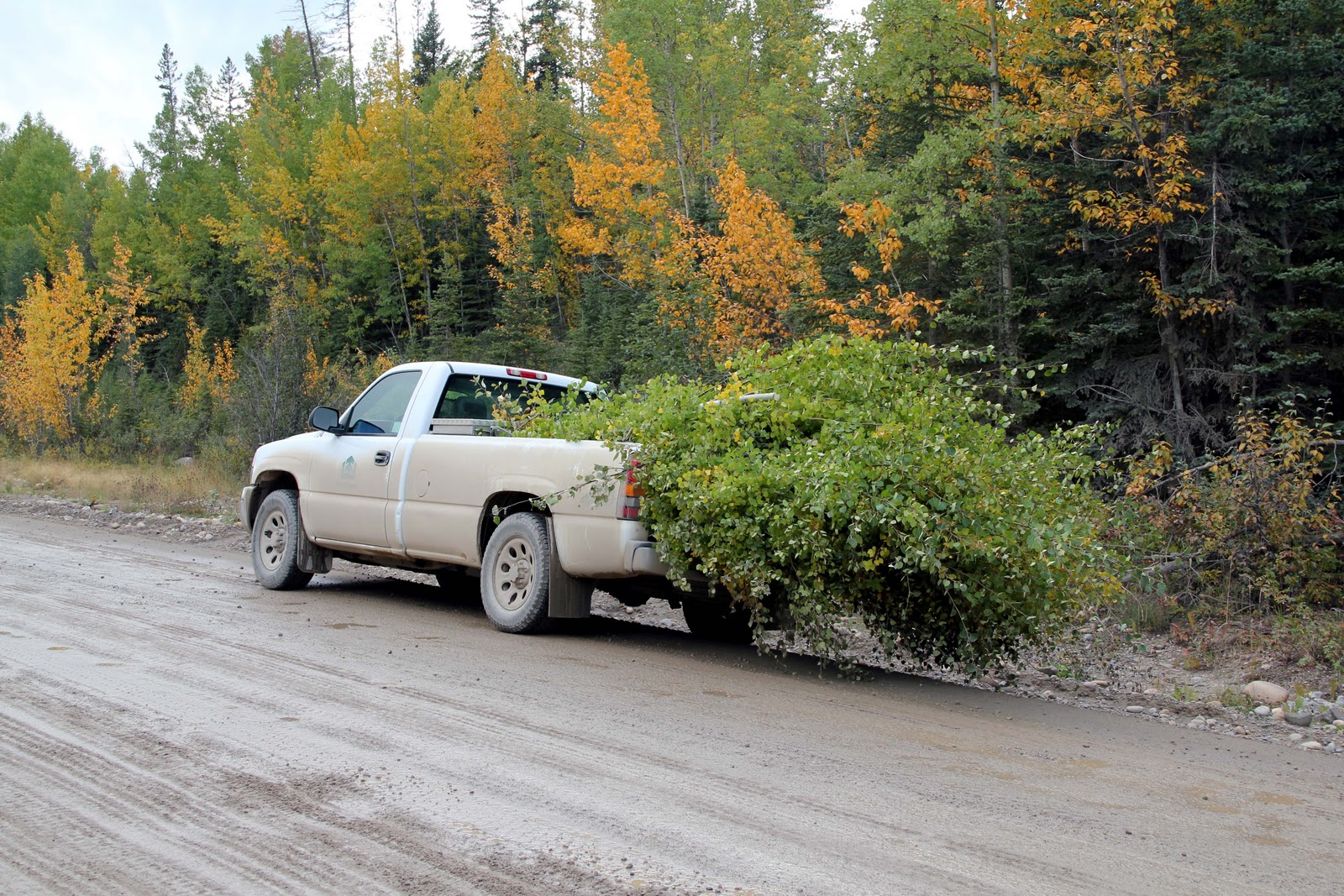
This year I gave the beavers 32 pickup loads of aspen and balsam poplar branches. The photos show one load. It might not seem like much, but the aspen saplings shown in the lake are about 5 m long. That's a lot of branches for me to haul. What's truly amazing though is the removal rate by the beavers. This particular load was dropped off in the late afternoon and it was entirely gone the next morning. Working through the night, the beavers cut up and hauled off the entire load, floating the loot about 300 m from the depot to the food cache they built beside the lodge. Of course all that work takes lots of energy, so the beavers are eating a lot of food as well. What amazes me though is how they take 32 loads like this and make them into one pile at the lodge. The underwater architecture of that pile must be amazing to cram so much into such a small space.
Sunday, September 19, 2010
Plastering the Lodge
Beaver winter preparations include additions to the lodge. There are usually some more logs and branches, but the main ingredient is a fresh coating of mud. When frozen the mixture of mud and wood becomes pretty much impenetrable armour for any predator that might try to break into the winter safehold. It's a little comical to watch the plastering process. The beaver dives to the bottom and scoops up a huge wad of wet mud. When swimming with this load the beaver is front-heavy and tends to sink, so more often the beaver surfaces right where it intends to exit the water. Standing upright on it's hind legs and using the tail for support, the beaver more or less waddles up the lodge to just the right spot.
I've yet to get really good photos of the lodge plastering. These two show a beaver just out of the water with the mud just visible, and a beaver high on the lodge about to dump it's load.
Thistle Clipping 2010
Last year volunteers clipped 2 heaping pickup loads of Canada thistle along the beaver dam while the plants were flowering. The idea was to remove the plant while all of it's energy was devoted to flowering but not to stimulate the roots to end up new shoots. Pulling the plants would have that effect - clipping is more time consuming but doesn't stimulate the roots. Over time, other plants should be able to out-compete the weakened thistles, and they should either die out or become much reduced.
The plan seems to be working. I finished clipping just one pickup load of thistles last week. So in a single year thistles have been reduced by half. And also where the thistles were still growing they didn't dominate the plant community like they did last year. Other plants are getting a foothold. I hope this positive trend continues next year!
Saturday, September 18, 2010
Fall Migration is Underway
Migrating birds wind up in unusual places. Every fall a few birds not usually found in this area stop at the Beaver Boardwalk for a brief rest or visit before moving on to their winter range. In the past several weeks I've seen long-billed dowitcher, pied-billed grebe, horned grebe, and sharp-shinned hawk. Yesterday evening an immature common grackle flew in to roost in the tall shrubs near the beaver feeding area. That was a surprise and I think the first record of common grackle at the Beaver Boardwalk. The horned grebe was a new record also. The list of birds observed at the Beaver Boardwalk continues to grow and now includes more than 150 species. The Whisky-jack Club maintains the official list and publishes a brochure updating the records as they come in.
Red-necked Grebe Rescue
September 14 was a pretty miserable day - cold and raining hard. Numerous puddles and the wet ground fooled a red-necked grebe into thinking the log yard at Hinton Wood Products sawmill was a water body. Not so, and once on the ground the grebe wasn't able to get airborne again. Grebes and loons must have water deep enough to get a run at if for liftoff. They patter across the water surface building speed using both their wings and their feet. For this purpose, the shallow puddles in the log yard wouldn't do.
Fortunately for the grebe, Dave Wallace, Neil Holder, and Morris Archibald came to the rescue. They caught the bird in a fishing net and deposited it in a cardboard box. Of course the bird didn't know they had good intentions and was quite indignant about the whole affair. A bit of a rodeo, according to the guys. After a short drive Morris opened the box at the Beaver Boardwalk and the grebe got a new start on Maxwell Lake. It was gone a few days later, probably carrying on with fall migration.
Dave Wallace took the photos with this post. The first shows the bird on the ground, and the second shows Morris releasing the grebe at Maxwell Lake.
Fortunately for the grebe, Dave Wallace, Neil Holder, and Morris Archibald came to the rescue. They caught the bird in a fishing net and deposited it in a cardboard box. Of course the bird didn't know they had good intentions and was quite indignant about the whole affair. A bit of a rodeo, according to the guys. After a short drive Morris opened the box at the Beaver Boardwalk and the grebe got a new start on Maxwell Lake. It was gone a few days later, probably carrying on with fall migration.
Dave Wallace took the photos with this post. The first shows the bird on the ground, and the second shows Morris releasing the grebe at Maxwell Lake.
Sunday, August 22, 2010
Beavers Grooming
Beavers spend a lot of time grooming their luxuriant fur to keep it clean and waterproof. The waterproofing comes from an oil they secrete from their anal glands and comb through their fur using a split claw on their hind leg. Recently it's been easy to see beavers grooming over at the feeding station by the Maxwell Lake picnic tables. After the free feast they gather as singles or small groups and set about the serious business of grooming. Sometimes they groom each other. Sometimes a youngster wants to play, and the older beaver decides to move and groom somewhere else. In this photo 3 yearlings have finished eating and have started to groom, while the animal on the left is still having dinner.
Subscribe to:
Posts (Atom)